Contact us
|
Whatsapp
Whatsapp:+86 13889850231
Whatsapp:+86 13889850231

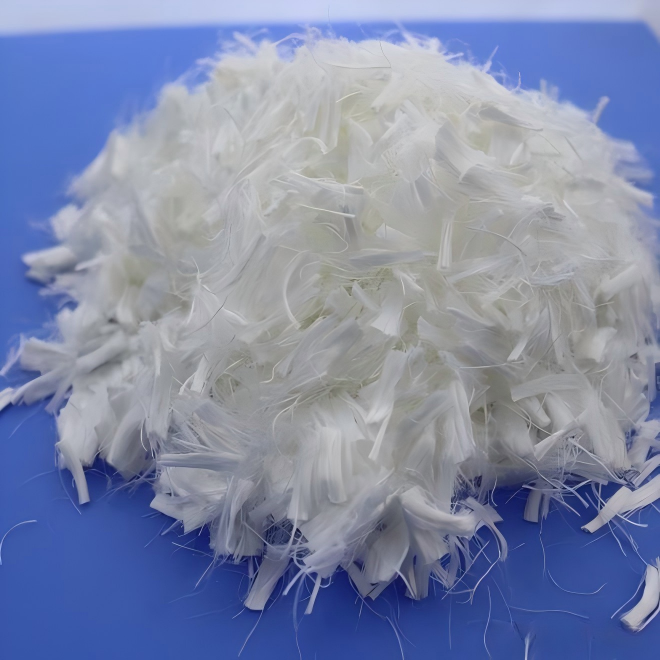
Polyester Fiber (PET fiber) is a synthetic engineering fiber manufactured from polyethylene terephthalate (PET) through a process of melt-spinning, stretching, and cutting. The product appears as white or off-white short fibers with good dispersibility and excellent alkali resistance, suitable for reinforcement modification of concrete, mortar, and asphalt mixtures.
Research on the application of polyester fiber in concrete dates back over thirty years. With increasing awareness of plastic waste management, the use of recycled polyester fiber produced from recycled PET bottles as concrete reinforcement has become an important direction combining environmental and engineering benefits. Polyester fiber is currently widely used in airport pavements, bridge deck overlays, tunnel linings, industrial flooring, and other concrete applications, as well as in asphalt pavement reinforcement.
| Parameter | Typical Range | Notes |
|---|---|---|
| Appearance | White or off-white short fibers | —— |
| Fiber Length | 12–19 mm | Customizable based on application |
| Fiber Diameter | 20–40 μm | —— |
| Tensile Strength | ≥ 500 MPa | —— |
| Elongation at Break | 15%–30% | —— |
| Modulus of Elasticity | ≥ 4000 MPa | —— |
| Density | 1.36–1.38 g/cm³ | —— |
| Melting Point | Approximately 255°C | —— |
| Alkali Resistance | Good | Suitable for cement-based materials |
Note: The above data represent typical performance ranges. Values may vary by grade. Please refer to the product test report for specific parameters.
Polyester fiber can effectively control plastic shrinkage cracks and thermal cracks in concrete. The fibers are randomly distributed in three dimensions within the concrete, forming a network structure that prevents the propagation and connection of micro-cracks. Studies indicate that the crack resistance of concrete specimens can be improved by over 5% with the addition of polyester fiber, with crack width reduction reaching over 46%. In airport pavement applications, when high-strength modified polyester fiber is added at a dosage of 1.4 kg/m³, concrete specimens show no surface cracking, indicating good crack resistance.
The addition of polyester fiber improves the flexural and bending strength of concrete. Research shows that at a C40 standard mix ratio, when polyester fiber is added at 0.8 kg/m³, the flexural strength can increase by approximately 30%. In wet-mix shotcrete with polyester fiber, adding 0.9 kg/m³ increases flexural strength by over 29%.
Polyester fiber significantly improves the impact toughness of concrete. The bridging effect of the fibers enables the concrete to absorb more energy under loading, delaying failure. Research indicates that impact toughness can increase by approximately 67% with the addition of 0.9 kg/m³ of polyester fiber. This characteristic makes polyester fiber concrete valuable for applications with high impact resistance requirements, such as airport pavements and heavy-load pavements.
The three-dimensional distribution of polyester fiber in concrete helps block crack channels and improve impermeability. Studies show that polyester fiber can increase the impermeability grade of concrete from P6 to P10, with chloride ion diffusion coefficient reduced by over 57%.
Polyester fiber concrete demonstrates good durability under freeze-thaw cycles and fatigue loading. The crack-blocking effect of the fibers reduces micro-crack propagation during freeze-thaw cycles, delaying performance degradation.
Airport pavements require high crack resistance, impact resistance, and durability. Polyester fiber concrete in airport runways in cold regions can effectively reduce early-age cracking and improve wear resistance, impact resistance, and impermeability. Research indicates that high-strength modified polyester fiber concrete at a dosage of 1.4 kg/m³ provides good overall performance for airport pavements.
In highway pavements and bridge deck overlays, polyester fiber improves crack resistance and fatigue resistance of the pavement. When added to asphalt concrete, polyester fiber improves high-temperature stability and low-temperature crack resistance, extending pavement service life.
In tunnel linings and shotcrete applications, polyester fiber reduces lining cracking and improves impermeability and impact resistance. Wet-mix shotcrete technology using polyester fiber has been applied in tunnel support under complex geological conditions, effectively controlling crack propagation.
Polyester fiber is suitable for large-area concrete applications such as industrial flooring, parking lots, and warehouses, reducing shrinkage cracks and improving surface quality. In precast concrete products, polyester fiber improves crack resistance and durability.
The recommended dosage of polyester fiber is typically 0.6–1.5 kg/m³. The specific dosage should be determined through trials based on engineering requirements and concrete mix design. Studies indicate that when fiber dosage is too low, the reinforcement effect is limited; when dosage is too high, it may affect concrete workability. For projects with high performance requirements such as airport pavements, a dosage range of 1.2–1.4 kg/m³ may be selected.
Polyester fiber should be added to the mixer together with the aggregates. Dry mixing for 30–60 seconds ensures uniform dispersion of the fiber, followed by the addition of water and wet mixing. Extended mixing time is recommended to ensure uniform fiber dispersion and avoid clumping.
Fiber length should be selected based on concrete aggregate size and engineering requirements. Common lengths are 12–19 mm. Shorter lengths may be selected for shotcrete applications to ensure smooth spraying.
Polyester fiber is available in standard type and high-strength modified type. Standard type is suitable for general crack control applications; high-strength modified polyester fiber is suitable for high-demand projects such as airport pavements and heavy-load pavements.
When selecting polyester fiber products, consider the following aspects:
1. Raw Material Quality
Quality polyester fiber should be manufactured from virgin PET resin or high-quality recycled PET raw materials, ensuring stable fiber performance. Attention should be paid to tensile strength and modulus of elasticity specifications.
2. Dispersion Performance
Dispersion is a key quality indicator. Quality products should disperse uniformly in concrete after mixing, with no obvious clumping.
3. Alkali Resistance
Polyester fiber should maintain good alkali resistance in cement-based materials, with performance maintained over long-term use.
4. Product Consistency
Fiber length, diameter, tensile strength, and other parameters should remain consistent across different batches to ensure stable project quality.
5. Supplier Qualifications
Choose suppliers that can provide product test reports, technical support, and stable supply capability.
Shenyang Xingzhenghe Chemical Co., Ltd. (www.xzhch.com) is a supplier specializing in concrete admixtures and construction chemical raw materials, established in 2009. The company's product range includes polyester fiber, polycarboxylate superplasticizers, sodium gluconate, lignosulfonate series, and Hydroxypropyl Methyl Cellulose.
The company has experience in the supply of polyester fiber products, serving applications including airport pavements, roads and bridges, tunnel engineering, and industrial flooring.
Polyester fiber, as a synthetic engineering fiber for concrete and asphalt reinforcement, provides value in crack control, improvement of flexural strength, and enhancement of impact resistance and impermeability. When selecting polyester fiber products, factors such as fiber performance specifications, dosage design, construction processes, and supplier capabilities may be considered.
Shenyang Xingzhenghe Chemical Co., Ltd. is committed to providing polyester fiber and related construction chemical raw material solutions to its customers.
Contact Us:
Company: Shenyang Xingzhenghe Chemical Co., Ltd.
Website: www.xzhch.com
Phone: +86 13889850231
Email: sales01@xzhch.com
Address: No. 33, Nan'er Road, Heping District, Shenyang, China
Consultation Hotline:
+86 13889850231
Email:sales01@xzhch.com
Address:No.33, Nan'er Road, Heping District, Shenyang, Liaoning Province
Copyright © 2002-2025 非商用版本 Registration:Liaoning ICP record