Contact us
|
Whatsapp
Whatsapp:+86 13889850231
Whatsapp:+86 13889850231

Cementitious materials serve as the "binding" core component in concrete, determining both strength and durability.
Portland cement is the primary cementitious material. Commonly used grades include P.O 42.5 (ordinary Portland cement) and P.O 52.5 (high-strength Portland cement). Cement typically accounts for 30%–70% of total cementitious content in concrete.
Modern concrete widely adopts composite cementitious systems combining "cement + mineral admixtures" to reduce costs and improve performance.
| Admixture | Main Components | Functional Features | Typical Dosage (% of Cement) |
|---|---|---|---|
| Fly Ash | SiO₂ + Al₂O₃ | Improves workability, reduces hydration heat, enhances long-term strength | 15%–40% |
| GGBFS (Slag) | Granulated blast-furnace slag | Improves durability, reduces hydration heat, enhances chemical resistance | 20%–60% |
| Silica Fume | Amorphous SiO₂ >85% | Significantly increases early and long-term strength, reduces permeability | 5%–15% |
| Limestone Powder | CaCO₃ | Filler effect, cost reduction, improved pumpability | 5%–15% |
Aggregates constitute the largest volumetric component in concrete, typically accounting for 70%–80% of total volume. Their quality directly affects mechanical properties and durability.
Chemical admixtures, though accounting for only 0.1%–5% of cementitious material by weight, can dramatically alter the fresh, setting, and hardened properties of concrete. They are known as the "fifth component" of modern concrete.
Water reducers are the most widely used admixtures, reducing mixing water requirements by dispersing cement particles, thereby increasing strength and durability.
| Type | Representative Products | Water Reduction Rate | Functional Features |
|---|---|---|---|
| Ordinary Water Reducer | Calcium lignosulfonate / Sodium lignosulfonate | 8%–12% | Natural polymer;兼具 retarding and air-entraining functions; cost-effective |
| High-Range Water Reducer | Naphthalene-based, Aliphatic | 15%–25% | High water reduction rate; good early strength development |
| High-Performance Water Reducer | Polycarboxylate (PCE) | 25%–40% | Highest water reduction; excellent slump retention; environmentally friendly |
Calcium lignosulfonate is the longest-used ordinary water reducer, derived from sulfite pulping spent liquor. It is abundant in supply, low in cost, and provides not only water reduction but also retarding, air-entraining, and dispersing functions. It is particularly well-suited for mass concrete and hot weather construction. It can be used as a standalone water reducer or compounded with naphthalene-based or polycarboxylate superplasticizers to enhance performance.
Retarders delay concrete setting time, preventing premature setting in high-temperature environments and ensuring workability during transport and placement.
Air-entraining agents introduce numerous uniformly distributed microscopic air bubbles (10–300μm diameter) into concrete, significantly improving freeze-thaw resistance. Essential for concrete structures in northern climates and cold regions. Common products include rosin-based agents and synthetic surfactants.
Fiber-Reinforced Concrete (FRC) has developed rapidly in recent decades. Different fiber types provide distinct reinforcement functions.
Steel fiber is the most mature fiber reinforcement material in concrete technology, made from carbon steel or stainless steel. It significantly improves tensile strength, flexural toughness, and impact resistance.
| Type | Shape Characteristics | Main Applications |
|---|---|---|
| Melt-extracted | Crescent cross-section; strong bond with matrix | Industrial floors, pavements |
| Sheared | Rectangular cross-section; lower cost | Tunnel linings, precast elements |
| Cut with hooked ends | Hooked ends for superior anchorage | Bridges, airport runways |
| Milled | Rough surface texture; high bond strength | Blast-resistant structures, heavy-duty floors |
Common specifications: Diameter 0.5–1.5mm, length 25–60mm, aspect ratio 30–100, tensile strength ≥600 MPa. Dosage typically 20–80 kg/m³ (volume fraction 0.25%–1.5%).
Alkali-resistant glass fiber is used in GRC (Glass Fiber Reinforced Concrete) products such as exterior decorative panels and sculptural components. It offers the advantages of lightweight and high strength.
Carbon Fiber Reinforced Concrete (CFRC) offers superior mechanical properties and electrical conductivity, used for structural strengthening and electromagnetic shielding. Higher cost limits it to specialized applications.
Geosynthetics are essential functional materials in civil engineering, playing critical roles in highways, railways, water conservancy, and environmental protection projects.
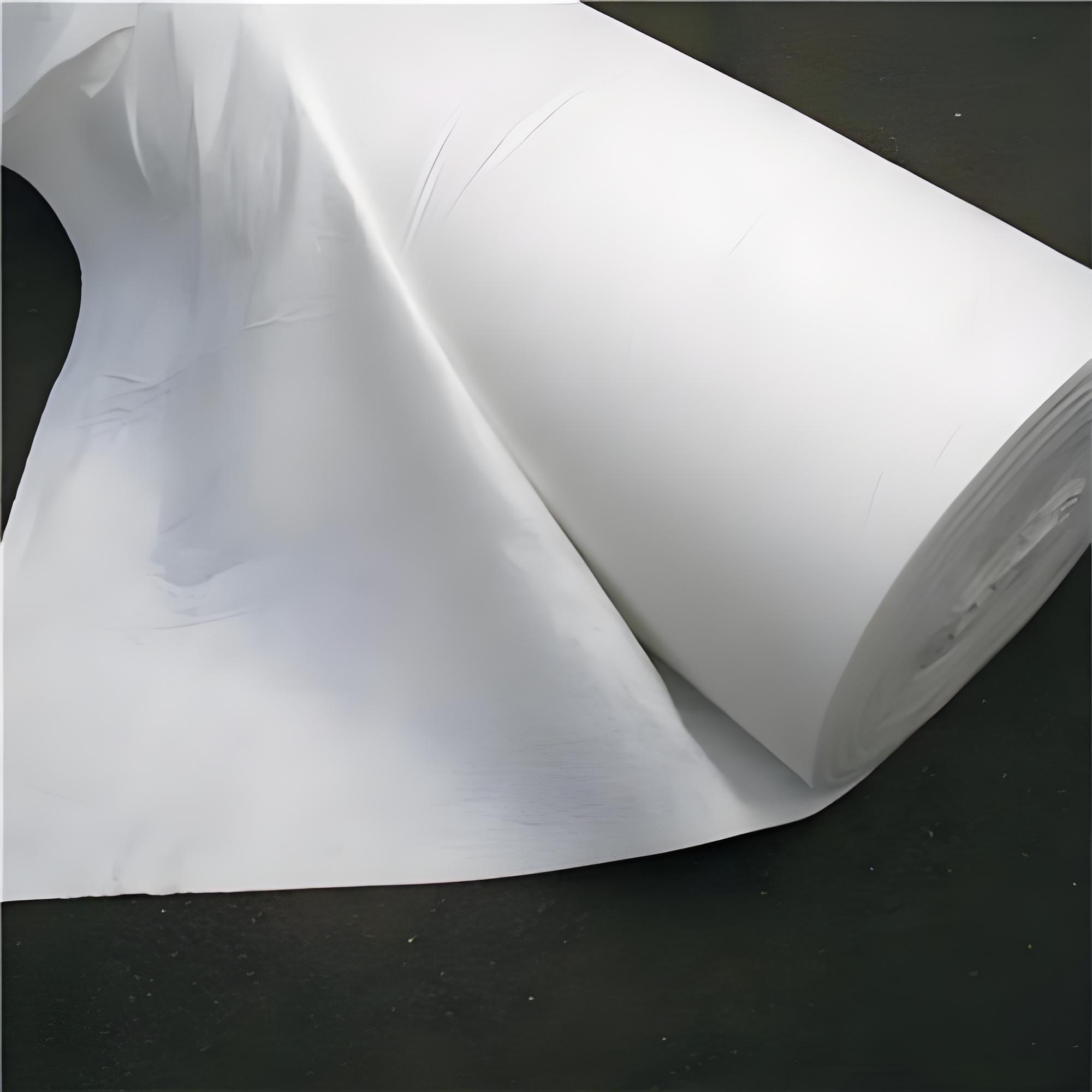
Geotextiles are permeable geosynthetic materials, classified by manufacturing process:
| Type | Manufacturing Process | Functional Features | Typical Applications |
|---|---|---|---|
| Short-fiber nonwoven | Short fibers needle-punched into fabric | Filtration, drainage, separation, protection | Subgrade reinforcement, embankment protection |
| Long-fiber spunbond | Continuous filaments spun directly into fabric | High strength, excellent durability | High-specification separation layers |
| Woven geotextile | Flat yarns woven | High tensile strength, low cost | Soft ground treatment, reinforced embankments |
Key specifications: Areal weight (100–600 g/m²), tensile strength, equivalent pore size (O₉₀), permeability coefficient.
Geomembranes are impermeable geosynthetic materials primarily used for seepage control. Common materials include HDPE (High-Density Polyethylene), LDPE, PVC, and EVA.
Three-dimensional cellular structure materials used for slope protection, vegetated slope stabilization, and soft ground treatment. Geocells can be filled with aggregate or soil to form a stable reinforced structural layer.
Curing compounds are sprayed onto concrete surfaces to form a film that reduces moisture evaporation, ensuring complete cement hydration. Ideal for large-area concrete (pavements, airport runways) where wet curing is impractical. Common types include wax-based and resin-based formulations.
Applied to formwork surfaces to prevent concrete adhesion, ensuring surface quality after stripping. Types include oil-based, water-based, and solvent-based release agents. Widely used in precast concrete plants.
| Engineering Type | Key Material Focus |
|---|---|
| High-rise buildings | High-strength cement + PCE superplasticizer + silica fume + pumping aids |
| Mass concrete (raft foundations) | Moderate/low-heat cement + fly ash + slag + calcium lignosulfonate (retarding) + sodium gluconate |
| Highway / Airport pavements | Portland cement + water reducer + air-entraining agent + steel/polypropylene fiber + curing compound |
| Tunnel engineering | Accelerator (shotcrete) + steel fiber + waterproof membrane/geotextile + waterstops |
| Water conservancy (dams) | Moderate-heat cement + large volumes of fly ash/slag + air-entraining agent + geomembrane for seepage control |
| Bridge engineering | High-strength cement + PCE superplasticizer + silica fume + corrosion inhibitor + geogrid |
| Landfill sites | HDPE geomembrane + geotextile + drainage pipe network |
| Industrial flooring | Steel fiber + wear-resistant aggregate + surface densifier/hardener |
Different projects demand different concrete performance characteristics. High-rise buildings require high strength and high flowability; mass concrete needs low hydration heat; tunnel linings need rapid setting and impermeability; pavements require flexural strength and freeze-thaw resistance. Material selection must always be driven by engineering requirements.
When performance requirements are met, prioritize cost-effective materials. For example: calcium lignosulfonate as an ordinary water reducer costs significantly less than PCE systems; fly ash and slag can substantially replace cement to reduce costs; manufactured sand is both economical and quality-controllable compared to natural sand.
When combining multiple materials, compatibility must be verified. For example: certain retarders cannot be mixed with accelerators; admixtures from different brands may cause flocculation or lose effectiveness; chloride-containing antifreeze agents must not be used in reinforced concrete.
All materials must comply with national or industry standards. Key standards include:
Concrete engineering requires six categories of materials: cementitious materials (cement, fly ash, silica fume, etc.), aggregates (river sand, crushed stone, manufactured sand), chemical admixtures (water reducers, retarders, accelerators, etc.), fiber reinforcement (steel fibers, polypropylene fibers), geosynthetics (geotextiles, geomembranes), and auxiliary construction materials (curing compounds, form release agents, waterstops).
Steel fibers primarily enhance tensile strength, flexural toughness, and impact resistance, suitable for industrial floors, tunnel linings, and structural applications. Polypropylene fibers mainly control plastic shrinkage cracking and improve impermeability and freeze-thaw resistance, with lower dosage requirements and better cost efficiency, widely used in pavements, bridge decks, and thin-walled structures.
Calcium lignosulfonate is a natural polymer water reducer with 8%–12% water reduction rate, retarding, dispersing, and air-entraining functions. It effectively reduces mixing water requirements, improves workability and flowability, and extends setting time (beneficial for hot weather construction) while lowering costs. It is commonly used as a standalone ordinary water reducer or as a dispersant component in high-efficiency water reducer systems.
Geotextile is a permeable geosynthetic material primarily used for filtration, drainage, separation, and reinforcement — it allows water to pass through while preventing soil particle migration. Geomembrane is an impermeable geosynthetic material primarily used for seepage control and containment in applications such as landfills, tailings ponds, and artificial lakes. The two are functionally complementary and are often used together.
The core challenge in mass concrete (such as raft foundations and dams) is excessive temperature differentials caused by cement hydration heat, leading to thermal cracking. Fly ash reduces cement usage, lowers hydration heat, and delays the temperature peak. Retarders (such as sodium gluconate and calcium lignosulfonate) extend setting time and further delay the temperature peak. Their combined use is a critical measure for temperature control in mass concrete.
Water reducer selection depends on: (1) Strength requirements — below C30 can use calcium lignosulfonate (ordinary water reducer); C30–C60 typically uses naphthalene-based or polycarboxylate systems (high-range); above C60 recommends PCE (high-performance). (2) Slump retention — long-distance transport or hot weather requires PCE with good retention. (3) Cost — calcium lignosulfonate is lowest cost, naphthalene-based is mid-range, PCE is highest but offers best overall efficiency.
Consultation Hotline:
+86 13889850231
Email:sales01@xzhch.com
Address:No.33, Nan'er Road, Heping District, Shenyang, Liaoning Province
Copyright © 2002-2025 非商用版本 Registration:Liaoning ICP record