Contact us
|
Whatsapp
Whatsapp:+86 13889850231
Whatsapp:+86 13889850231

A subsurface drainage system may work well immediately after construction and then gradually lose performance.
One common problem is clogging.
Symptoms may include:
When these problems occur, the drainage pipe itself is often blamed first.
However, perforated drainage pipe clogging is rarely caused by the pipe alone.
In most projects, long-term drainage performance depends on the interaction between:
soil + filter layer + geotextile + drainage aggregate + pipe perforations + installation.
This means a pipe with adequate diameter and ring stiffness can still lose drainage capacity if the surrounding filtration system is not suitable.
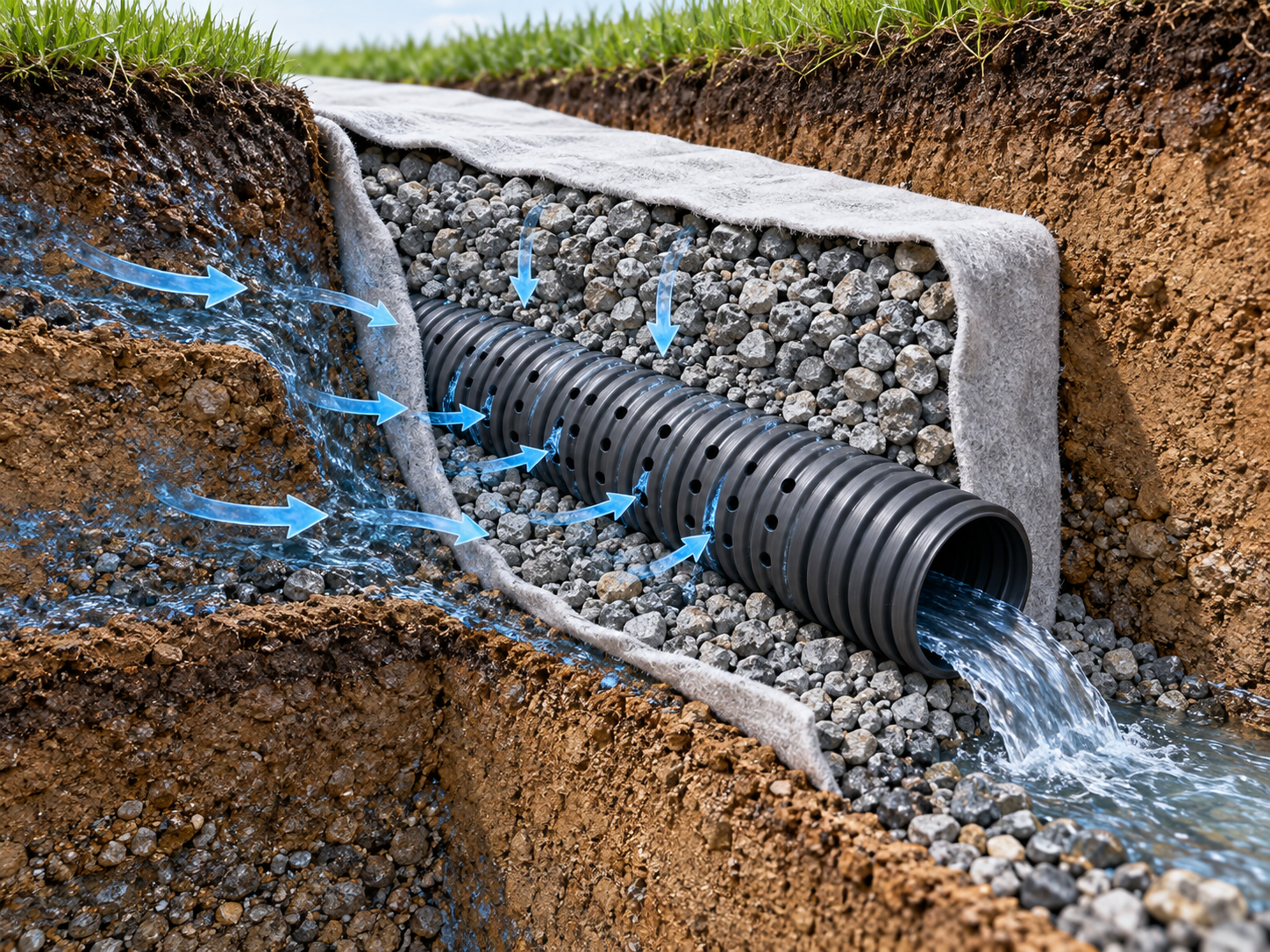
A perforated drainage pipe is designed to collect water from the surrounding soil.
But groundwater rarely contains only clean water.
It may carry:
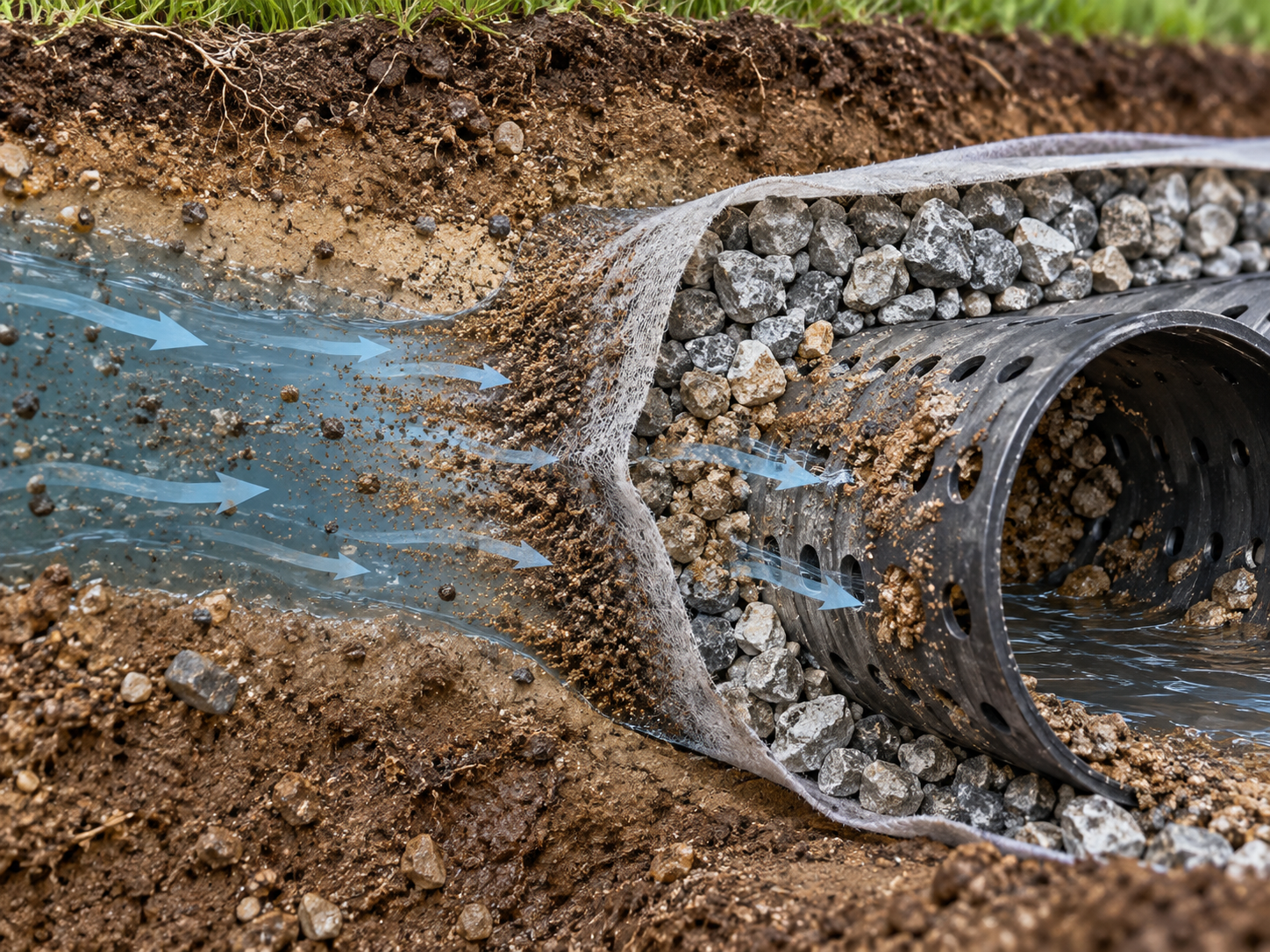
If these particles enter the pipe continuously, they may accumulate inside the drainage system.
Over time, this can reduce:
A filter system is therefore used to allow water to enter while limiting the movement of soil particles.
Several mechanisms can contribute to clogging.
Common causes include:
In many civil engineering projects, the main concern is movement of fine soil particles into the drainage layer.
Water moves from the surrounding soil toward the lower-pressure drainage zone.
As water flows, it may carry small soil particles.
The risk is higher when the soil contains:
If there is no effective filtration layer, these particles may migrate into:
This process may be gradual, which is why the drainage system can appear normal immediately after installation.
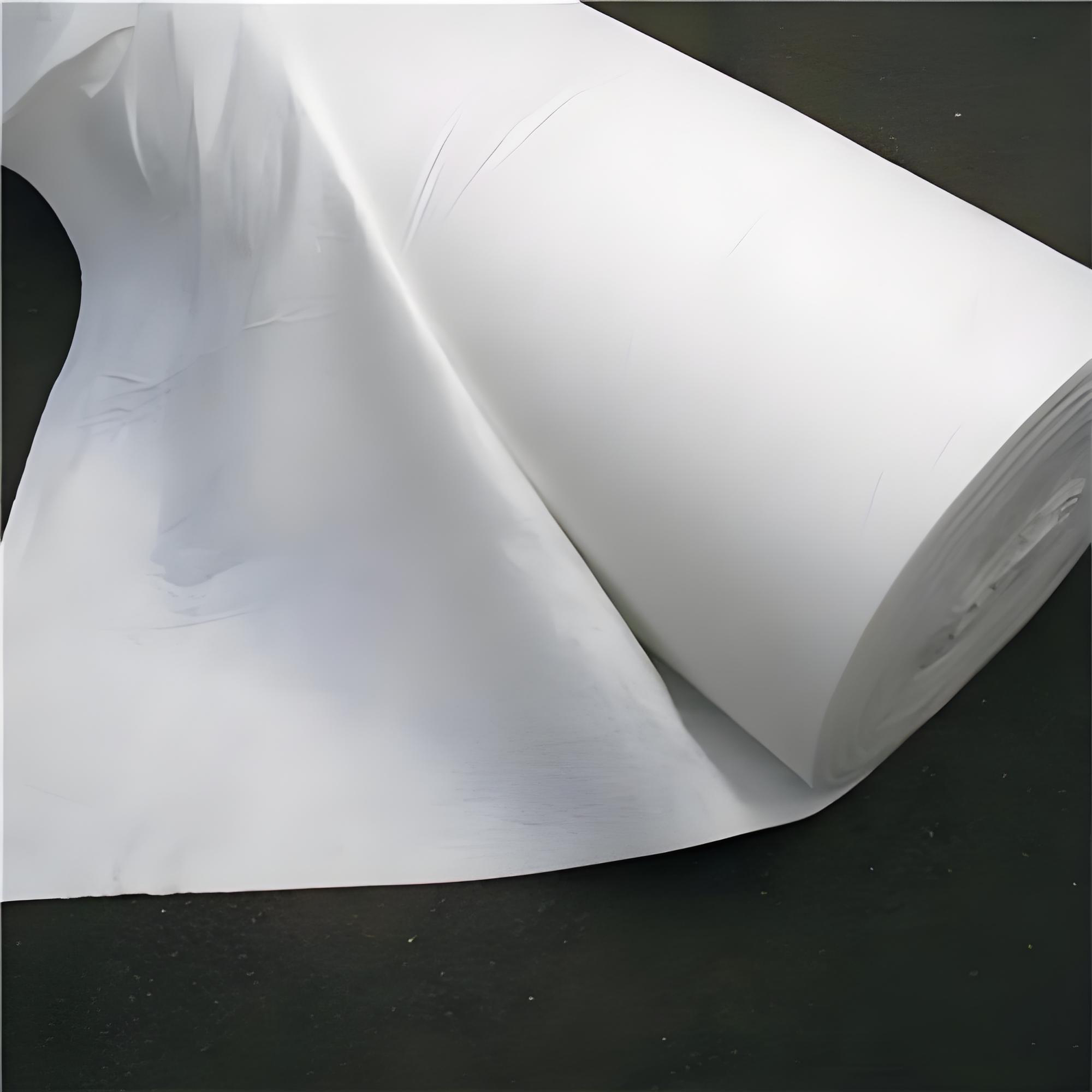
Geotextile is commonly used as a separation and filtration layer.
Its purpose is not simply to “wrap the pipe.”
A suitable drainage geotextile should help:
The correct geotextile depends on soil and hydraulic conditions.
A product that works in coarse sand may not behave the same way in silty soil.
Geotextile contains pores.
These openings need to be balanced.
If the openings are too large:
If the openings are too small:
Therefore, geotextile selection is a filtration problem rather than simply choosing the densest fabric.
Not necessarily.
Geotextile mass per unit area is only one product characteristic.
Two geotextiles with similar weight may have different:
Therefore, drainage design should not rely only on GSM or fabric weight.
For filtration applications, hydraulic and opening-size characteristics are also important.
It may seem logical to use a very fine geotextile to stop as much soil as possible.
However, if the geotextile is much finer than necessary, particles may accumulate at its surface.
This can create a low-permeability layer.
The result may be:
So the objective is not to block all particles.
The objective is to maintain a stable soil-filter interface while allowing water to pass.
Blinding occurs when particles accumulate on the surface of the geotextile.
Instead of entering and blocking the internal pore structure, soil forms a layer against the fabric.
This layer may reduce hydraulic conductivity.
Blinding risk depends on:
In some soils, a thin stable filter layer can form without causing serious drainage problems.
In other conditions, excessive accumulation may reduce flow.
Internal clogging occurs when particles enter the pore structure of the geotextile and remain trapped.
This may reduce the available flow channels.
The risk can increase when:
This is one reason soil conditions should be considered before selecting filtration fabric.
Soil gradation describes the distribution of different particle sizes.
A coarse, well-graded soil behaves differently from:
The amount and size of mobile particles influence filtration requirements.
For drainage design, useful soil information may include:
Without soil information, geotextile selection becomes more uncertain.
Yes.
Even if the pipe remains open, the aggregate surrounding it can gradually fill with fine soil.
This reduces pore space.
When pore space decreases:
Geotextile separation around the aggregate layer is often used to reduce this contamination.
Drainage aggregate should provide interconnected voids for water flow.
If the aggregate itself contains excessive fines, the drainage layer starts with reduced permeability.
Construction materials should therefore be controlled so that the drainage zone is not filled with:
Clean aggregate cannot replace correct filtration, but it helps maintain available flow paths.
Perforated drainage pipes use holes or slots to allow water into the pipe.
The design may vary by product.
Important considerations include:
If openings are very small, particles may block them.
If openings are too large relative to the surrounding filter system, more sediment may enter.
Therefore, pipe perforation and surrounding filtration should be considered together.
This depends on the pipe design, drainage concept and manufacturer guidance.
For some systems, perforation orientation is designed to collect rising groundwater from the surrounding bedding.
For other products, perforations may be distributed around much of the circumference.
Therefore, installation should follow:
A generic orientation rule should not be applied to every perforated pipe.
Water collected by the drainage system needs a reliable outlet.
If the pipe has:
water and sediment may remain inside.
Standing water can allow suspended particles to settle.
Repeated deposition can gradually reduce internal flow area.
Therefore, pipe alignment is part of clogging control.
In many drainage systems, positive slope is required to maintain discharge.
However, design should still consider:
The objective is a controlled continuous flow path, not simply the steepest possible pipe.
Actual slope should follow engineering design conditions.
An unintended low point can act like a sediment trap.
Water slows or remains inside the pipe.
Suspended solids can settle.
Over time, sediment may accumulate.
Low points can result from:
Correct trench preparation helps reduce this risk.
Buried thermoplastic pipes rely on both:
If installation is poor, excessive deformation may occur.
This can:
Ring stiffness is therefore relevant, but it is only one part of performance.
Proper bedding and side support remain important.
Yes.
Ring stiffness and filtration perform different functions.
SN8 describes a ring-stiffness class.
It does not mean:
A mechanically adequate pipe can still lose hydraulic performance if filtration is poorly designed.
A larger pipe provides more internal flow area.
But the amount of water reaching that pipe depends on:
If the surrounding filter becomes clogged, increasing pipe diameter alone may not solve the problem.
Drainage should be considered as a complete hydraulic system.
Both may be used for subsurface drainage, but their structures are different.
A perforated pipe mainly collects water through openings and carries it through the internal pipe channel.
A plastic blind drain typically provides a three-dimensional drainage structure with a relatively large flow surface.
Depending on the project, a blind drain may be used:
The choice depends on space, drainage direction and hydraulic requirements.
It can be used in some systems, but direct pipe wrapping and full drainage-trench filtration are not always equivalent.
If only the pipe is wrapped, fines may still migrate into the surrounding aggregate layer.
A design may instead use geotextile around:
The suitable configuration depends on the soil and drainage design.
When native soil is fine and drainage aggregate is coarse, direct contact between them may allow fines to move into the aggregate voids.
Wrapping the drainage layer with geotextile can help keep these materials separated.
This can support:
But fabric overlaps and installation quality still matter.
Geotextile sheets often need to overlap during installation.
If gaps remain between sheets:
Overlap requirements depend on:
Workers should avoid leaving open seams in the filtration layer.
Yes.
Potential damage may come from:
A tear can create a direct path for soil migration.
Therefore, the geotextile needs sufficient mechanical properties for the installation method.
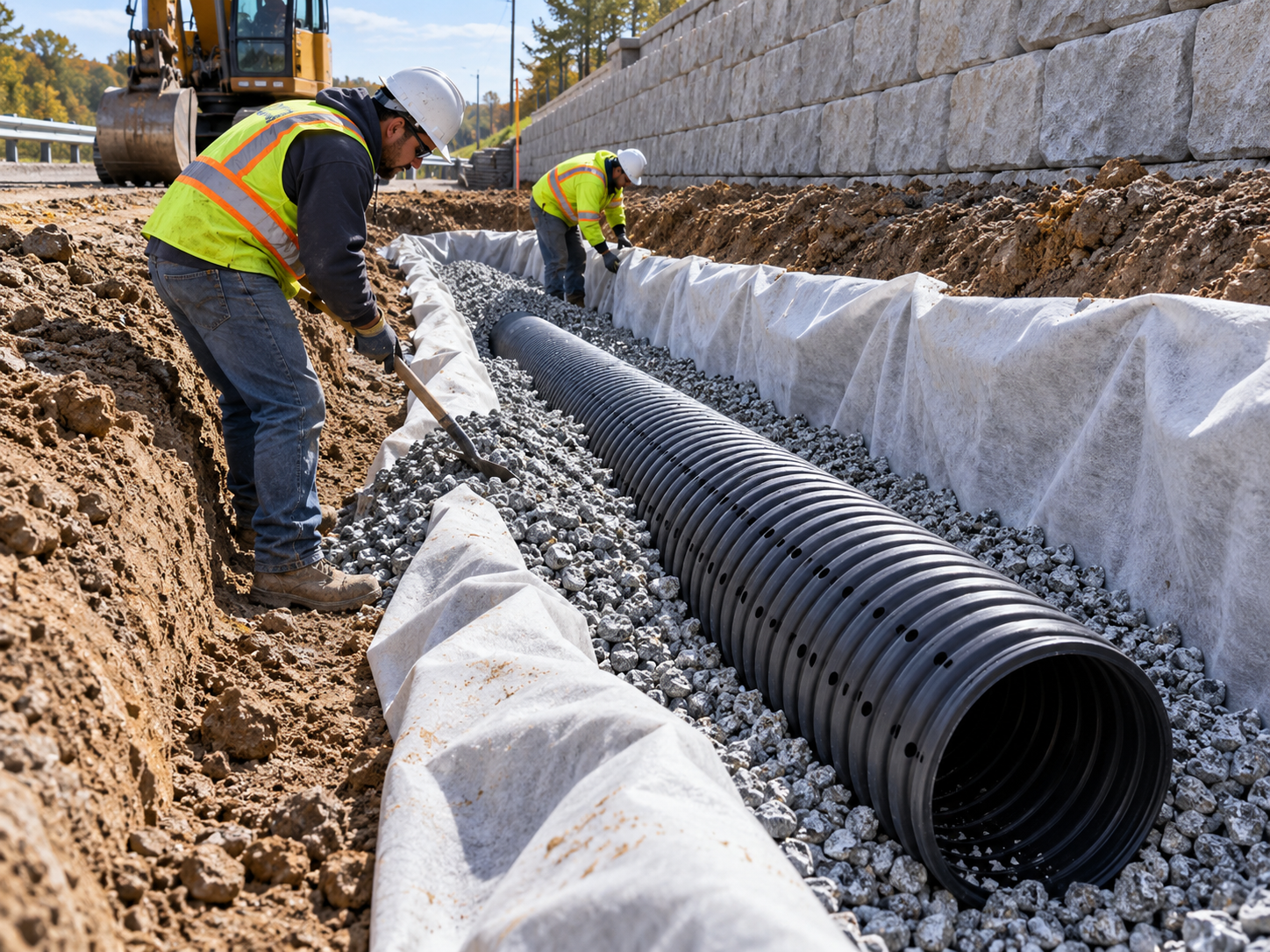
Even a correctly selected geotextile and pipe can be compromised during backfilling.
Problems can include:
Backfill should be placed according to the project installation procedure.
Construction-stage contamination is sometimes overlooked.
An open drainage trench may receive:
If these materials enter before the system is closed, the drain may already be partially blocked when construction is completed.
Keeping the drainage zone clean during installation is therefore important.
Behind a retaining wall, groundwater moves toward the drainage layer.
If filtration is poor:
As drainage capacity decreases, water pressure behind the wall may increase.
For this reason, wall drainage design should consider both:
Road subgrades may contain silty or fine-grained soils.
Traffic loading and repeated wetting can also influence soil movement.
If fines migrate into the drainage layer, the system may gradually lose permeability.
This can contribute to:
Geotextile separation can be part of the solution where appropriate.
Slope drainage may receive seepage carrying fine soil.
If water flow paths concentrate sediment into perforated pipes or drains, blockage may develop.
A slope drainage system may therefore require consideration of:
Different slope conditions require different arrangements.
In landscaped or vegetated areas, roots may grow toward persistent moisture.
Where pipe joints or openings provide access, root intrusion can occur in some environments.
Project design may need to consider:
This is different from soil-particle clogging but can also reduce drainage performance.
Some groundwater contains dissolved minerals.
Changes in water chemistry may produce deposits inside a drainage system.
Depending on the environment, deposits may form from:
These conditions are site-specific.
If groundwater chemistry is unusual, the drainage design may require additional evaluation.
Subsurface drainage systems are difficult to inspect after burial.
For longer systems, designers may consider:
These features can make it easier to:
Maintenance requirements depend on project scale and expected sediment load.
Some drainage systems can be cleaned by water flushing if suitable access is provided.
However, flushing does not correct the original cause if the surrounding filtration system continues to allow sediment entry.
Repeated clogging after cleaning may indicate a problem with:
Maintenance and root-cause analysis should therefore be considered together.
For a project using perforated drainage pipes, buyers may ask for information such as:
For a complete drainage system, it may also be useful to confirm compatibility among:
A useful inquiry may include:
For engineered projects, drawings can help the supplier understand the drainage arrangement.
A drainage line usually requires more than straight pipe.
Depending on the layout, the project may need:
Poorly matched connections may create:
Therefore, the fittings system should be considered together with the pipe.
Before the drainage system is buried, it is useful to verify:
Problems are much easier to correct before backfilling than after the system is buried.
Common causes include fine soil migration, unsuitable filtration, sediment entering during construction, poor slope and contamination of the drainage aggregate.
A geotextile is intended to provide filtration and separation, but it should be matched to the soil and hydraulic conditions. It is not simply a complete barrier to all particles.
No. Weight and thickness alone do not determine filtration performance. Opening size and permeability are also important.
Yes. Ring stiffness relates to structural resistance, not filtration. A pipe can have adequate stiffness and still clog if the surrounding drainage system is unsuitable.
That depends on the project. Some systems wrap the pipe, while others use geotextile around the entire aggregate drainage zone.
Yes, if the filtration system does not adequately control particle migration.
Possible causes include sediment accumulation, filter clogging, pipe deformation, settlement, biological intrusion or mineral deposits.
Long-term performance of a perforated drainage pipe depends on much more than the pipe itself.
A reliable subsurface drainage system requires coordination between:
soil → geotextile → drainage aggregate → perforations → pipe → outlet.
If fine particles are not controlled, sediment can gradually enter the drainage layer and reduce hydraulic capacity.
If filtration is too restrictive, water flow may also be reduced.
Therefore, drainage design should balance:
For roads, retaining walls, slopes and other underground drainage projects, material selection should be based on the complete system rather than on pipe diameter or ring stiffness alone.
Shenyang Xingzhenghe Chemical Co., Ltd. supplies perforated corrugated drainage pipes, plastic blind drains, geotextiles and related civil engineering materials. Product specifications, dimensions, fittings information and project-related material details can be provided according to customer requirements. Final material selection and installation should follow the project design and actual site conditions.
Consultation Hotline:
+86 13889850231
Email:sales01@xzhch.com
Address:No.33, Nan'er Road, Heping District, Shenyang, Liaoning Province
Copyright © 2002-2025 非商用版本 Registration:Liaoning ICP record